Eric Opoku Design Portfolio
LOVEBUG

When We Got Your Love Locked In
Project Overview:
LoveBug is a dating platform designed for meaningful, long-term relationships. The opportunity was to create a more intentional and trustworthy alternative to casual dating apps. It targets users seeking serious connections. I worked in a cross-functional team with UX designers, data scientists, and software engineers, contributing to research, ideation, and prototyping.
Role: UI/UX Research & Designer
Timeline: 4-day Sprint


Problem Statement:
Dating-app users seeking meaningful relationships often struggle to judge compatibility in swipe-first experiences, leading to low trust, decision fatigue, and superficial interactions. This can reduce confidence in matches and limit meaningful conversations, engagement, and long-term product retention.
User Research & Insights:
Methods
Conducted user interviews to develop personas and analyzed secondary research on dating behaviors, fatigue, and trust in algorithms.
Key Insights
- Low trust in match quality
- Swipe fatigue causes burnout
- Onboarding lacks a good balance between depth and simplicity
- Transparency boosts user confidence
- Users want meaningful, long-term connections

Persona: David Chen
Age: 28
Location: Toronto, Canada
Occupation: Marketing Specialist
Archetype: The Intentional Matcher
Bio
David is a young professional seeking a meaningful relationship through dating apps. Despite frequent use, many matches feel shallow and misaligned, leading to skepticism about how compatibility is determined. David wants a more transparent and intentional experience that explains why matches are relevant.
Goals
-
Find a meaningful, long-term relationship
-
Understand why matches are recommended
-
Build genuine, engaging connections
-
Use dating apps efficiently
Pain Points
-
Matches feel superficial and appearance-driven
-
Low trust in matching algorithms
-
Conversations lack depth and fade quickly
-
Swipe fatigue from low-quality matches
-
Onboarding feels tedious
Behaviors
-
Swipes frequently but selectively
-
Reviews photos, then evaluates bios
-
Uses apps in short sessions
-
Takes breaks due to burnout
Motivations
-
Desire for authentic, compatible connections
-
Need for clarity and trust in matching
-
Preference for meaningful over casual interactions
Quote
“I don’t just want more matches. I want to understand why someone is right for me.”

UI Inspiration Boards
The UI inspiration board explored modern dating interfaces, focusing on clarity, trust, and intuitive interactions. During the sprint, we used it alongside AI tools to rapidly generate high-fidelity mockups, ensuring a cohesive, engaging, and user-centered experience.


UI Library
The LoveBug UI Library follows Atomic Design, building from foundations to full screens for consistency and scalability. Designed for a sprint, it uses modular components to ensure clarity, trust, and seamless interaction across the experience.


Urgent High Fidelity
During the sprint, wireframes defined the core flow. As engineers needed visuals to build, we quickly created high-fidelity mockups using Claude and Figma. Designs were developed for both mobile and web to ensure flexibility, clarify interactions, and support faster, aligned implementation.
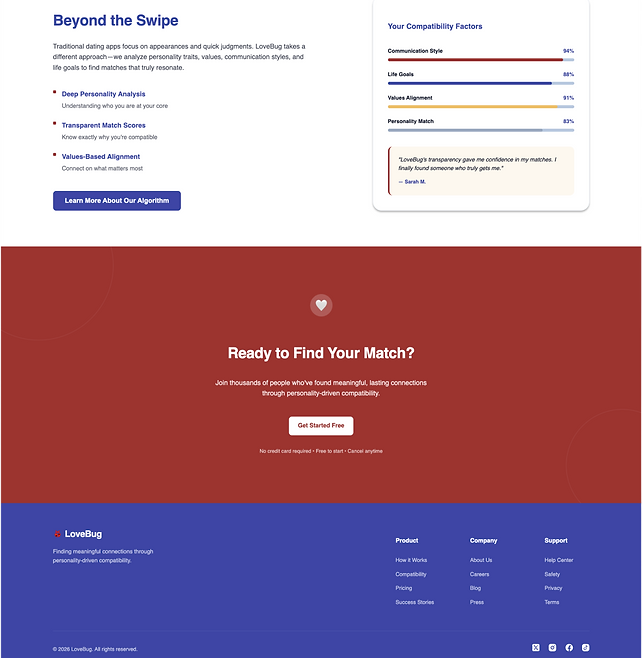
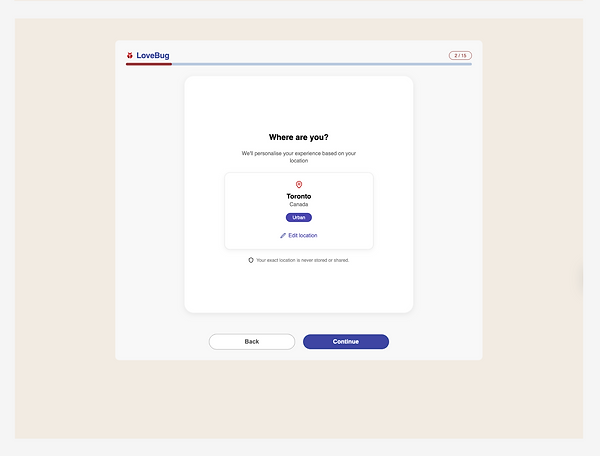
Site Designs
A personality-driven dating platform that builds trust through transparent compatibility and meaningful connections.


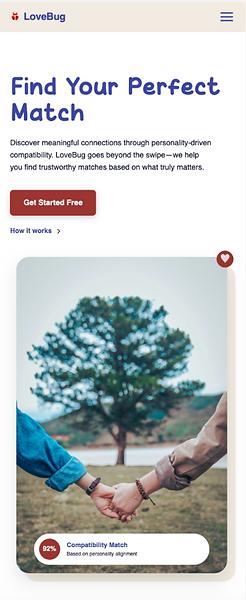
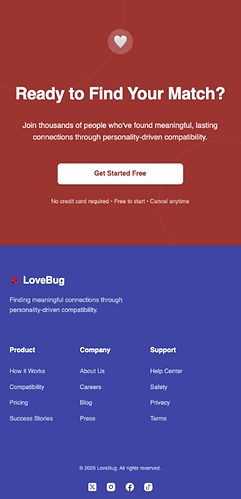
Mobile App Designs
A guided, mobile-first dating app that reduces swipe fatigue by delivering curated matches, real conversations, and clear compatibility insights.


Questionnaire
This initial concept demonstrates how the questionnaire is structured, guiding users to answer thoughtfully and identify their most compatible match.


Prototype
The final solution is a mobile-first prototype that shifts dating from swiping to personality-driven matching. It features guided onboarding, clear compatibility results, and a match feed that highlights shared traits and encourages meaningful conversations.


Photo Upload
A guided photo upload screen that prompts users to add a main profile image and supporting photos, reinforcing profile quality and readiness before proceeding.
Quiz Interface
A guided question screen that captures user preferences through simple, structured choices, helping build accurate personality insights for compatibility matching.


Trait Insights
A results screen that translates user responses into a clear personality archetype, supported by quantified traits to guide meaningful and compatible matches.
Match Feed
A personalized match feed showcasing compatible profiles with key traits, bios, and match percentages, enabling users to quickly identify and initiate meaningful conversations.


Prototype Demo
The video walkthrough demonstrates how users move seamlessly from answering questions to discovering aligned matches.
Outcome
The LoveBug concept uses personality-driven matching and clear compatibility signals to support more intentional connections and reduce reliance on superficial swiping. As the four-day sprint did not include formal usability testing, its impact remains a design hypothesis. If implemented, success would be measured through onboarding completion, match-to-message conversion, user confidence, and retention.
Reflection
What I Learned
-
Trust and transparency are essential in algorithm-driven experiences
-
Simplifying complex logic improves user confidence and engagement
-
Clear, guided onboarding reduces friction and improves usability
What I Would Do Next
-
Conduct deeper usability testing to validate the matching logic
-
Refine onboarding to further reduce friction and improve clarity
-
Enhance personalization and compatibility explanations
-
Collaborate with engineers to further develop the app into a scalable product